For years, conversations about masculinity have become increasingly heated.
Some people argue that traditional ideas of manhood are harming men and those around them. Others believe masculinity itself is being unfairly criticised or weakened. Between these opposing views, many men are left confused.
They hear that they should be strong—but not intimidating.
They are encouraged to express their emotions—but sometimes feel judged when they do.
They are told to lead—but warned not to dominate.
They are expected to be confident—but criticised if confidence appears too assertive.
So, what is the difference between toxic masculinity and healthy masculinity?
The answer begins with an important distinction:
Masculinity is not inherently toxic.
Courage, strength, discipline, ambition, leadership, resilience, protectiveness and responsibility can all be positive qualities. They have helped men overcome hardship, support families, build communities, defend others and contribute to society.
The problem is not masculine strength.
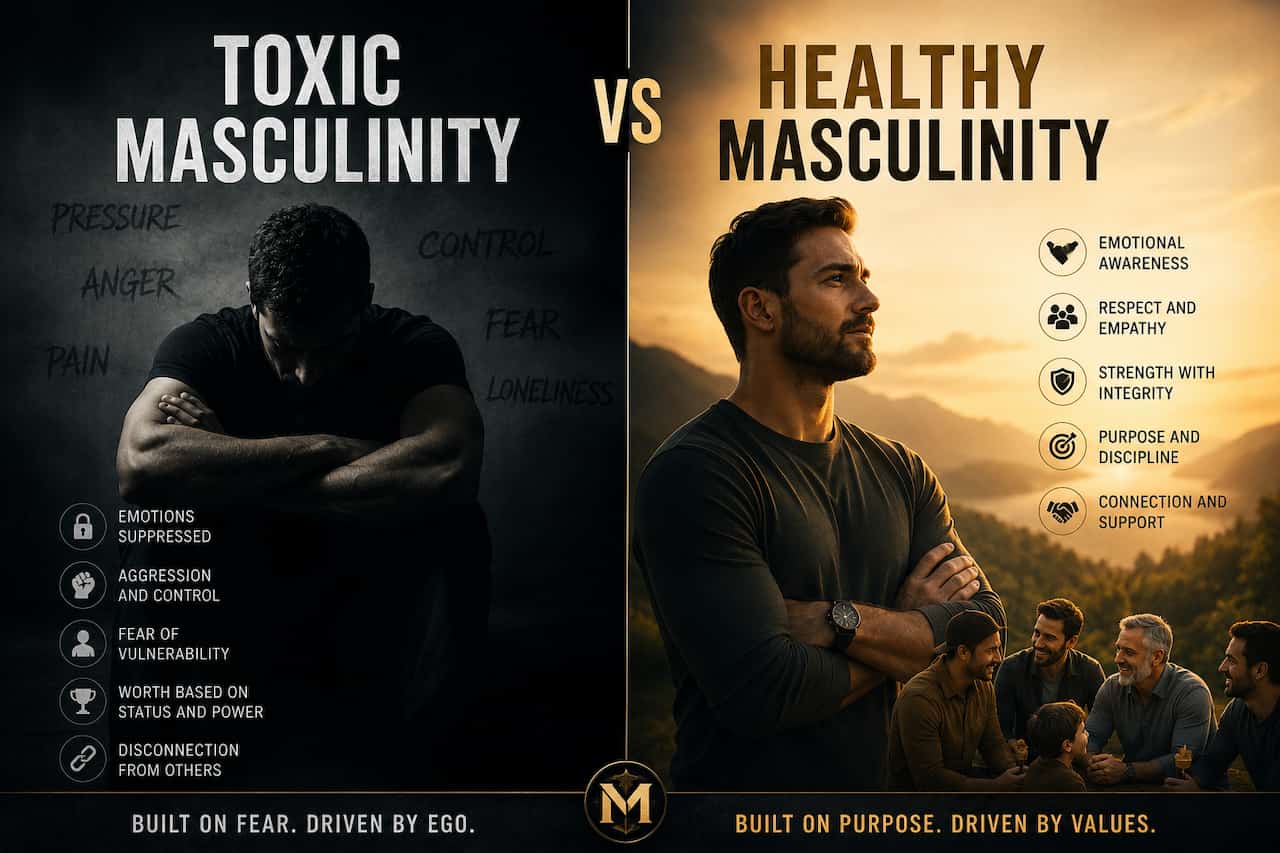
The problem arises when masculinity is reduced to rigid rules that teach men they must dominate, suppress emotion, reject vulnerability, seek control or prove their worth through aggression and status.
Healthy masculinity does not ask men to become less masculine.
It challenges men to become more mature, self-aware and responsible.
What Is Toxic Masculinity?
Toxic masculinity does not mean that men are toxic.
It does not mean that every traditionally masculine trait is harmful.
Instead, the term describes harmful beliefs and behaviours associated with rigid or distorted expectations of manhood.
These expectations may teach men that:
- A “real man” never cries
- Asking for help is weakness
- Anger is the only acceptable emotion
- Men must always be dominant
- Being emotionally vulnerable makes a man weak
- Success is measured only by money, power or sexual conquest
- Men must control their partners
- Violence is an acceptable way to prove strength
- A man must always win, even at the expense of others
- Respect must be demanded through fear
These beliefs can harm everyone—including men.
A man who has been taught to hide every emotion may struggle to form close relationships. A man who believes he must always appear powerful may refuse support when he needs it most. A man who measures his worth only through status may feel empty despite achieving financial success.
Toxic masculinity places men inside a narrow box.
Healthy masculinity gives them the strength to grow beyond it.
What Healthy Masculinity Looks Like
Healthy masculinity is built on character rather than stereotypes.
A healthy man strives to become physically, mentally, emotionally, and morally stronger—not to control others, but to better serve his family, friends, community, and himself.
Healthy masculinity includes:
- Taking responsibility for your actions.
- Showing courage in difficult situations.
- Protecting rather than intimidating.
- Treating everyone with dignity and respect.
- Communicating honestly.
- Managing emotions without being controlled by them.
- Standing up for what is right, even when it is unpopular.
- Remaining humble while continuing to grow.
Strength and kindness are not opposites. In fact, they often reinforce one another.
The Difference Between Strength and Aggression
One of the most damaging misunderstandings about masculinity is the belief that strength and aggression are the same.
They are not.
Strength is the ability to remain grounded under pressure.
Aggression is often an attempt to control others through intimidation, hostility or fear.
A strong man can remain calm during conflict.
An insecure man may feel compelled to shout, threaten or dominate.
A strong man can defend his boundaries without humiliating others.
An insecure man may use anger to hide fear or vulnerability.
Strength is controlled.
Aggression is often uncontrolled.
True power is not the ability to make other people afraid of you. It is the ability to manage your own emotions, impulses and behaviour—even when you are angry.
Strength Without Integrity Is Dangerous
Physical strength, intelligence, wealth, or influence are valuable only when guided by integrity.
History is filled with powerful individuals who caused enormous harm because their character failed to match their abilities.
True strength is demonstrated through self-control.
It is remaining calm during conflict.
It is refusing to abuse your position.
It is protecting those who are vulnerable.
It is keeping your word even when doing so is inconvenient.
Anyone can lose control.
It takes character to remain in control.
Emotional Control Is Not Emotional Suppression
Many men were raised with the belief that emotional restraint is a sign of maturity.
There is value in self-control. No one should be ruled by every emotion they experience.
But self-control and emotional suppression are not the same.
Emotional control means:
“I understand what I am feeling, and I choose how to respond.”
Emotional suppression means:
“I am not allowed to feel this, so I will hide it.”
Suppressed emotions do not always disappear. They may emerge as anger, withdrawal, resentment, anxiety, unhealthy coping habits or emotional distance.
Healthy masculinity allows men to experience the full range of human emotions without surrendering control.
A healthy man can say:
“I am hurt.”
“I am afraid.”
“I am overwhelmed.”
“I need help.”
“I was wrong.”
These statements do not make a man weak.
They require honesty, self-awareness and courage.
Leadership vs Dominance
Leadership is a valuable masculine quality.
A good leader provides direction, accepts responsibility and helps others succeed. He listens, communicates clearly and remains accountable for his decisions.
Dominance is different.
Dominance often seeks control for its own sake. It may rely on fear, intimidation, manipulation or the belief that one person’s needs always matter more than everyone else’s.
A healthy leader asks:
“How can I help us move forward?”
A controlling person asks:
“How can I make everyone do what I want?”
Leadership builds trust.
Dominance demands submission.
A man does not become a leader because he is louder, wealthier or more physically powerful. Leadership is earned through competence, integrity, responsibility and service.
Confidence vs Ego
Healthy confidence is rooted in self-respect.
It allows a man to recognise his strengths without believing he is superior to others. It helps him take action, handle criticism and recover from failure.
Ego, by contrast, often depends on constant validation.
A fragile ego may:
- Need to win every argument
- Interpret disagreement as disrespect
- Reject criticism immediately
- Seek constant admiration
- Put others down to feel powerful
- Become defensive when challenged
A confident man does not need to prove his value in every conversation.
He can listen without feeling diminished.
He can admit mistakes without believing that he has lost status.
He can celebrate another person’s success without seeing it as a threat.
Confidence says:
“I know who I am.”
Ego says:
“Everyone must recognise that I am important.”
Confidence Doesn’t Need to Be Loud
Some people mistake arrogance for confidence.
The healthiest men rarely feel the need to prove themselves constantly.
Quiet confidence comes from competence, preparation, and self-respect.
Confident men:
- Celebrate the success of others.
- Admit when they don’t know something.
- Continue learning.
- Accept constructive criticism.
- Lead through actions rather than intimidation.
Real confidence is secure enough to remain humble.
Independence vs Isolation
Independence is valuable.
A capable man can solve problems, make decisions and take responsibility for his life.
But extreme self-reliance can become isolation.
Some men believe they must handle every struggle alone. They may avoid asking for help because they fear appearing weak or becoming a burden.
Yet no successful person builds a meaningful life entirely alone.
Healthy masculinity recognises that seeking support can be an act of strength.
A man may need advice from a mentor, encouragement from a friend, support from family or professional guidance during a difficult period.
Asking for help does not remove responsibility.
It can help a man meet his responsibilities more effectively.
Ambition vs Status Obsession
Ambition can be a powerful force.
It motivates men to develop skills, build businesses, support families, create opportunities and pursue meaningful goals.
But ambition becomes unhealthy when a man believes his worth depends entirely on external success.
Money, career achievements, physical appearance and social status can change.
If identity is built only on these things, a setback can feel like a complete loss of self.
Healthy ambition asks:
“What can I build, contribute or improve?”
Status obsession asks:
“How can I prove that I am better than everyone else?”
There is nothing wrong with wanting success.
The danger comes when success becomes a substitute for character, connection or purpose.
A man can be wealthy and deeply insecure.
He can have status and still lack self-respect.
He can be admired publicly while feeling isolated privately.
True success should strengthen a man’s life—not become the only reason he believes his life has value.
Protection vs Control
Many men feel a strong desire to protect the people they love.
At its best, protectiveness is an expression of care, responsibility and loyalty.
But protectiveness becomes unhealthy when it turns into control.
A protective man supports another person’s safety and independence.
A controlling man restricts another person’s choices and calls it love.
A protective partner asks:
“How can I support you?”
A controlling partner says:
“You must do what I say because I know what is best.”
Healthy masculinity recognises that love is not ownership.
You can care deeply for someone without controlling their life.
Responsibility Is One of the Greatest Masculine Traits
A defining characteristic of healthy masculinity is accountability.
Healthy men take ownership of their decisions.
They work to improve rather than making excuses.
They provide support where they can.
They honour their commitments.
They understand that maturity means accepting responsibility even when life feels unfair.
Responsibility creates trust.
Trust builds strong families, friendships, workplaces, and communities.
Respect Is Earned, Not Demanded
Some men seek respect through fear.
Healthy men earn respect through consistency.
People respect those who:
- Keep their promises.
- Treat others fairly.
- Remain dependable.
- Speak honestly.
- Handle success with humility.
- Show integrity during difficult moments.
Lasting respect cannot be forced.
It must be earned over time.
Healthy Masculinity Builds Rather Than Destroys
Healthy masculinity is not passive.
It is active, disciplined and purposeful.
It encourages men to build:
- Strong bodies
- Healthy relationships
- Useful skills
- Financial stability
- Meaningful careers
- Supportive communities
- Emotional resilience
- A life guided by values
A healthy man does not measure his power by how many people he can control.
He measures it by what he can create, protect, improve and contribute.
He understands that strength without integrity can become dangerous.
But strength guided by wisdom can become a force for good.
The Qualities of a Healthy Man
Healthy masculinity is not one personality type.
A quiet man can be masculine.
An expressive man can be masculine.
A father, entrepreneur, artist, teacher, athlete, carer or community leader can express masculinity in different ways.
There is no single personality that defines a “real man.”
However, healthy masculinity often includes qualities such as:
- Strength: The ability to endure hardship and take constructive action
- Responsibility: Owning your choices and their consequences
- Courage: Doing what is right despite fear
- Discipline: Following through even when motivation is low
- Emotional intelligence: Understanding and managing emotions
- Integrity: Living according to your values
- Respect: Treating others with dignity
- Confidence: Trusting your abilities without needing superiority
- Compassion: Using strength to support rather than harm
- Humility: Remaining open to learning and correction
- Purpose: Directing your energy toward meaningful goals
- Accountability: Admitting mistakes and working to repair them
These qualities do not weaken masculinity.
They give it depth.
How Men Can Move Towards Healthier Masculinity
Healthy masculinity is not achieved by following a perfect set of rules.
It is developed through daily choices.
Start by asking yourself:
Do I express strength through self-control or intimidation?
Can I acknowledge difficult emotions without allowing them to control me?
Do I lead by example or try to dominate others?
Do I pursue success because it is meaningful—or because I need approval?
Can I accept criticism without becoming defensive?
Do I respect the boundaries and independence of others?
Am I willing to ask for help when I need it?
These questions are not accusations.
They are opportunities for growth.
Every man has habits, beliefs or behaviours that can be improved. Maturity is not pretending to be perfect. It is being willing to learn.
The Future of Masculinity
The future does not require men to abandon strength.
It requires men to use strength wisely.
It does not require men to reject leadership.
It requires leadership rooted in responsibility rather than control.
It does not require men to suppress emotion.
It requires emotional awareness combined with self-discipline.
It does not require men to abandon ambition.
It requires ambition guided by purpose and integrity.
The strongest version of masculinity is not loud, aggressive or constantly seeking approval.
It is secure enough to listen.
Disciplined enough to remain calm.
Confident enough to admit mistakes.
Courageous enough to be emotionally honest.
Responsible enough to accept consequences.
Compassionate enough to care.
And strong enough to protect without controlling.
Final Thoughts: Strength With Character
The conversation about masculinity should not be about making men smaller.
It should be about helping men become stronger in ways that improve their lives and the lives of those around them.
Toxic masculinity narrows manhood into a rigid performance:
Never show weakness.
Always dominate.
Never ask for help.
Win at all costs.
Control others.
Prove your worth.
Healthy masculinity offers a better path:
Be strong—but remain compassionate.
Be confident—but stay humble.
Lead—but listen.
Protect—but do not control.
Be emotionally honest—but practise self-control.
Pursue success—but never sacrifice your integrity.
Take responsibility—but know when to seek support.
A healthy man does not need to dominate others to feel powerful.
He develops the strength to lead himself.
And that may be the most important form of masculinity of all.
Real strength is not about becoming harder.
It is about becoming wiser, more disciplined, more responsible and more secure in who you are.
That is how manhood is unlocked.
Leave a Reply